
Agricultural carbonate lime - safe deacidification and high reactivity
Fast and precise regulation of soil pH
Granulated agricultural lime with the highest reactivity and a high CaCO₃ content, designed to quickly improve soil pH. Thanks to excellent solubility it rapidly unlocks the phosphorus and potassium stored in the soil. It improves the use of nutrients from mineral fertilization.
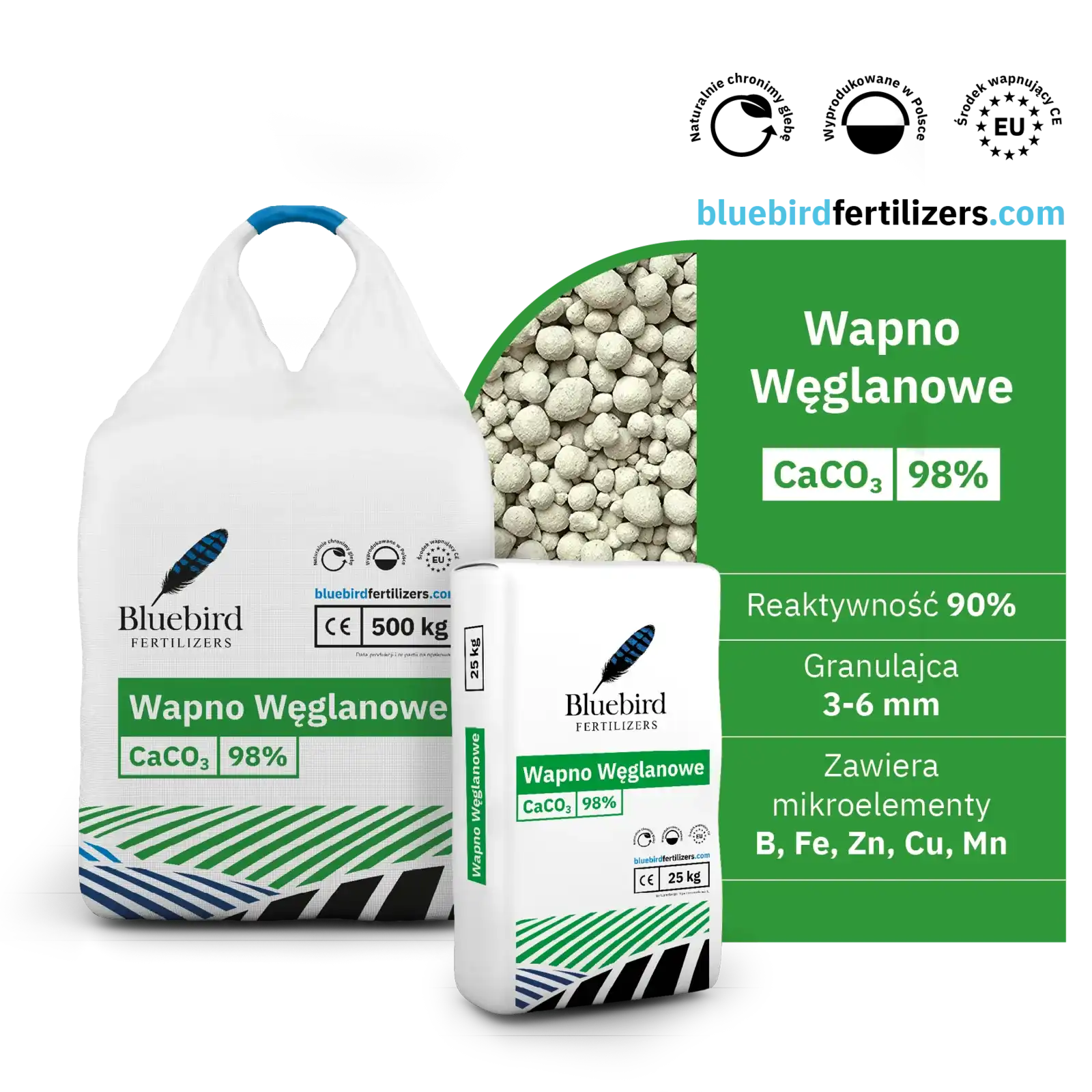
Fast and precise regulation of soil pH
Product parameters
| CaCO₃ content | 98% |
|---|---|
| Reactivity | 90% |
| Granulation | 3–6 mm |
| Spreading width | up to 36 m |
Why choose Carbonate Lime?
Bluebird Carbonate Lime is a fertilizer with a very high calcium content and the highest reactivity, fully soluble in water. It comes from a young, natural deposit, making it a source of lime that plants can absorb quickly.
The hard, uniform granulate allows exceptionally precise, even spreading with a standard fertilizer spreader — with full control over field coverage.
The granules do not damage plants and do not volatilize. With rainfall they quickly reach the root zone, providing excellent building material for plants while deacidifying the soil.
- Highest reactivity and fast action
- 3–6 mm granules
- Precise spreading with a standard spreader
- Containing micronutrients
Application
See in which situations Carbonate Lime performs best.
Rapid increase in soil pH.
Supply of nutritional calcium for plants.
Better use of NPK nutrients.
Intervention use at any stage of plant development.
Support for the mineralization of crop residues.
Frequently asked questions
Practical answers about this product. Match rate and timing to the soil test, crop and current product label.
How fast does Carbonate Lime raise soil pH?
Carbonate Lime starts reacting when the granules dissolve, but there is no fixed time for every soil. Bluebird lists 90% reactivity for this product; moisture, soil type, pH, particle behavior and application rate determine how quickly the measured pH changes.
What makes Carbonate Lime from young deposits more reactive than standard limestone?
Bluebird describes Carbonate Lime as coming from a young natural deposit and lists 90% reactivity. A younger, softer raw material can react more readily than less reactive limestone, but the practical result still depends on grinding or granulation, moisture and soil conditions.
How does Carbonate Lime unlock phosphorus and potassium bound in acidic soil?
By reducing excessive acidity, Carbonate Lime can improve the conditions for phosphorus and potassium availability and uptake. Bluebird describes its high-reactivity granules as helping unlock these nutrients; the response depends on the starting pH, soil chemistry and moisture.
How does Carbonate Lime assist in breaking down crop residues after harvest?
Carbonate Lime is listed for supporting the mineralization of crop residues after harvest. By correcting soil acidity and supplying calcium, it can support the soil conditions involved in decomposition; the speed also depends on moisture, temperature, residue type and microbial activity.
How quickly do Carbonate Lime granules dissolve into the root zone after rainfall?
The product description says the granules move toward the root zone with rainfall after dissolving, but it does not promise a fixed number of hours or days. Dissolution and movement depend on rainfall, soil moisture, granule condition and soil structure.
Need technical documentation?
In the Attachments section you will find product data sheets, safety data sheets, EU declarations of conformity and technical specifications available to download as PDF files.