
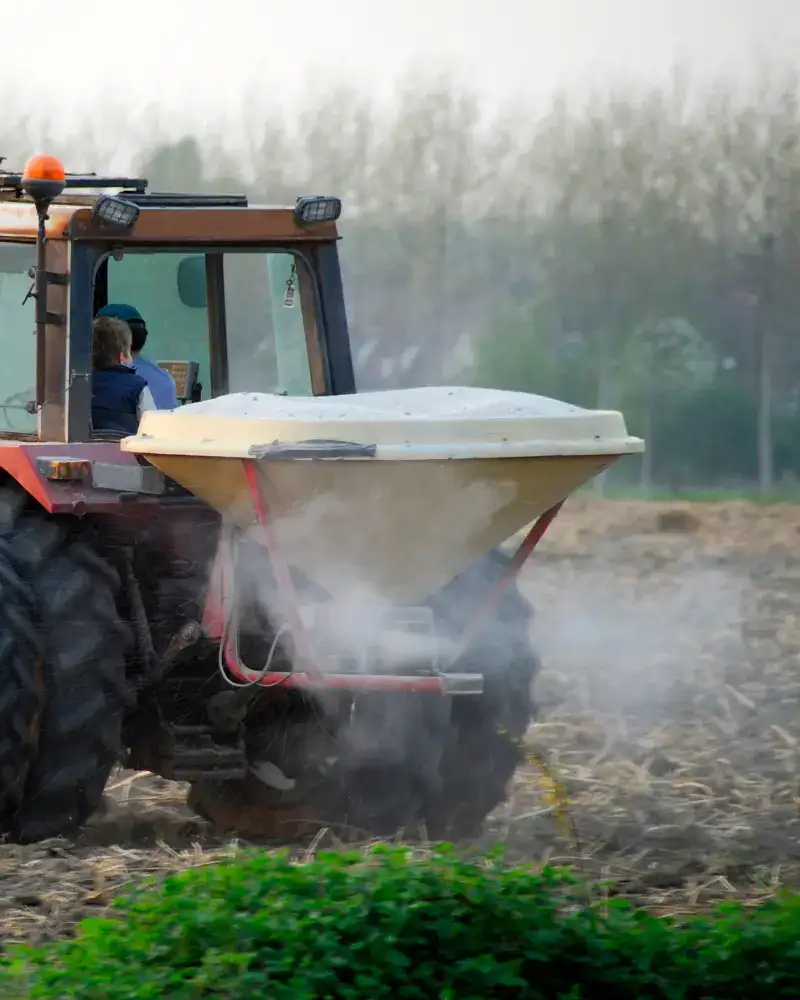
Setting up a fertilizer spreader correctly requires coordinating the machine's working width, the tractor's forward speed and the physical properties of the granules. Errors when calibrating the spreader result in uneven spreading, which causes losses and disrupts crop development. The spreading chart supplied by the manufacturer provides the basis for adjustments, but the final setting should always be verified in the field. Find out how to prepare your equipment correctly to ensure even emergence and avoid wasting expensive material.
Which parameters determine the spreader vane settings?
The spreader vane settings depend on the selected working width, the tractor's forward speed, the target application rate per hectare and the properties of the granules, such as bulk density and particle diameter. Precise equipment calibration requires accounting for the air resistance acting on the particles being thrown.
The lighter the granules, the faster they lose kinetic energy, making it necessary to adjust the throwing angle. The spreader vane settings determine the point at which the fertilizer falls onto the disc, shaping the spreading pattern in the field. An error at this stage causes missed strips or overlaps, affecting the farm budget and causing uneven crop emergence.
How do you read the manufacturer's spreading charts correctly?
The manufacturer's spreading chart should be read as a theoretical starting point, cross-referencing the desired fertilizer application rate with the planned working width and the tractor's average driving speed. Each machine has a dedicated fertilizer spreading chart or an extensive specification for advanced centrifugal spreaders.
This document specifies the optimum size of the metering opening and the position of the drop point on the disc. However, these values are developed under laboratory conditions for perfectly calibrated materials. Before heading into the field, the farmer must verify these data by carrying out a stationary calibration test. If you are unsure about the settings for a particular batch of material, consult an experienced advisor.
Working width and tractor forward speed
Maintaining a constant tractor forward speed while keeping to the declared working width is the only way to achieve even field coverage with machines that lack variable-rate systems. Increasing speed with a fixed metering opening proportionally reduces the application rate per square metre of crop. To maintain the correct application rate, the operator must synchronize the power take-off speed with the forward speed.
To check the tractor's actual speed:
- Mark out a measured distance of exactly 100 metres in the field.
- Drive this distance at working engine speed, measuring the time with a stopwatch.
- Calculate the actual driving speed, which often differs from the tractor's instrument readings because of wheel slip.
- Compare the result with the parameters required by the particular fertilizer spreader to adjust the final metering opening.
How do you set up a funnel-type or Strumyk fertilizer spreader?
Correctly setting up a funnel-type fertilizer spreader requires precise adjustment of the metering opening, symmetrical installation of the vanes and rigidly securing the machine at the correct height above the crop. Working with a single disc can be demanding because of the asymmetrical spreading pattern and the high susceptibility of light fractions to crosswind drift.
To compensate for these limitations, selecting material with the right properties is essential. Using uniform, heavy granules with a regular shape stabilizes the particles' flight path after they leave the disc, minimizing wind drift and allowing even field coverage to be maintained.
How do you spread fertilizer with a funnel-type spreader to prevent losses?
To spread fertilizer without losses using a single-disc machine, secure the three-point linkage arms with lateral stabilizers and drive the tractor with overlapping passes. Understanding how to spread fertilizer with a funnel-type spreader requires accounting for its specific throwing pattern, in which most of the material lands to the right of the tractor's centreline.
Keeping the spreader level relative to the ground prevents fertilizer from being blown into the air. Using high-quality raw materials eliminates the need for chemical, artificial binders or additives. The granules' exceptional resistance to crumbling solves the problem of material being broken up by the disc vanes, allowing the spreading pattern specified by the manufacturer to be maintained.
How do you set up a fertilizer spreader for grass and cover-crop seeds?
Setting up the equipment for seed spreading requires partially closing the metering opening, shortening the throwing vanes and reducing the disc speed. Setting up a fertilizer spreader for grass differs considerably from configuring it for heavy carbonates or minerals. Cover-crop seeds are light, offer considerable resistance in the hopper and are susceptible to mechanical damage.
To prepare the machine for this material:
- Reduce the spreading disc speed so that centrifugal force does not break the delicate seeds.
- Set the low-speed agitator to its gentlest operating setting.
- Carry out a stationary calibration test, collecting the discharged material in a measuring bag.
- Configure the boundary deflector to prevent seeds from being thrown beyond the designated meadow or pasture.
Why is granule quality the foundation of precision farming?
Granule quality determines whether fertilizer can be integrated with variable-rate systems without the risk of blocking the machine's feeders. For a fertilizer spreader to do its job properly, hard, spherical granules of controlled size are essential. Their consistent geometry and constant bulk density guarantee a predictable flight path, while resistance to crumbling prevents dust from forming as the throwing vanes operate.
Fertilizers that are too soft break down in the hopper, making the spreading chart for a funnel-type Strumyk fertilizer spreader useless because the material's physical properties have changed. Using a stable, highly hard structure is the only way to maintain the set working width and eliminate losses on headlands.
How do Bluebird granules protect machinery and budgets?
The production process for Bluebird calcium fertilizers protects machinery and increases the profitability of crops. Instead of loose materials, we use advanced granulation. The hard, spherical form eliminates uneven spreading and delivers specific benefits:
- Pure composition and ideal size: The 3-6 mm granules are made from micronized powder without adding chemical glues or heavy metals.
- An end to dust: The hard structure prevents fertilizer from crumbling and clogging the spreader, ensuring uninterrupted operation.
- Even spreading up to 36 m: The spherical shape guarantees a stable flight path and precise centrifugal spreading over a width of up to 36 metres.
- VRA compatibility and rapid payback: The fertilizer works with variable-rate systems, providing a return on investment within 14-18 months on areas exceeding 50 ha.
Choose Bluebird granules - precise spreading and budget protection
Correct spreader calibration delivers the expected results only when combined with the right raw material. Highly reactive Bluebird calcium granules measuring 3-6 mm do not crumble in the hopper or clog the metering mechanisms, guaranteeing a consistent flight path and even field coverage over widths of up to 36 metres. By eliminating the risk of missed strips and troublesome dust, you avoid wasting expensive material and make full use of your machinery's potential.
Protect your yields and choose technology that cares for soil fertility and your machinery's efficiency. Explore the full fertilizer range at: https://bluebirdfertilizers.com/.